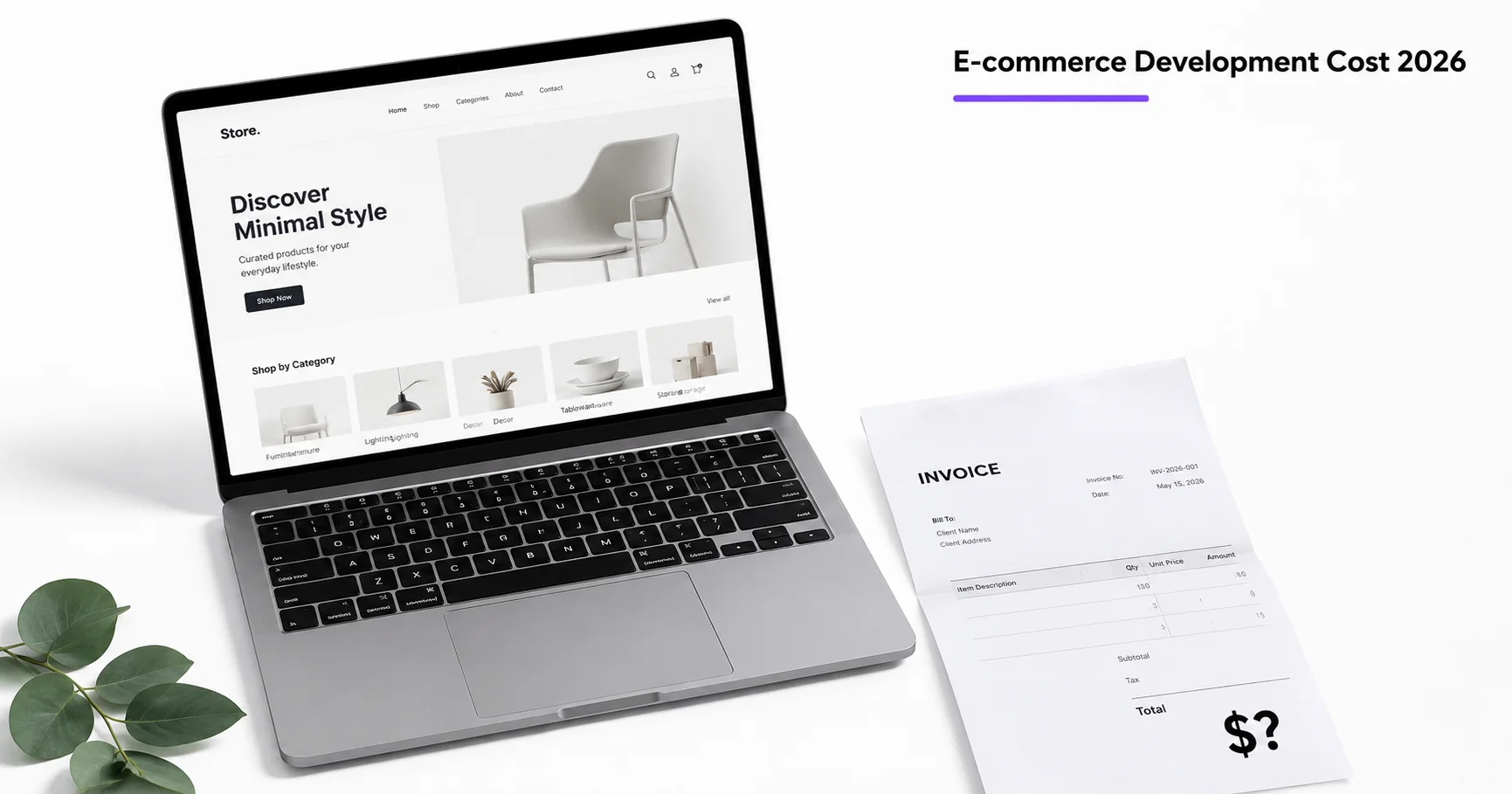
You asked an agency to build your e-commerce website. One quoted you $4,000. Another said $25,000. A third sent a 12-page proposal for $80,000.
Same project. Three wildly different numbers.
This isn’t a coincidence — it’s by design. Most agencies structure their quotes to obscure, not clarify. And by the time you notice the gaps, you’re already six months into a contract.
This post breaks down what an e-commerce website actually costs to develop in 2026 — by platform, by project type, and by everything agencies hope you won’t ask about until after you’ve signed.
Why E-commerce Development Quotes Vary So Wildly
Before the numbers, you need to understand what’s actually driving the price gap. There are four main variables:
Platform. Building on Shopify, WooCommerce, Magento, or a fully custom stack are completely different cost structures. An agency that specialises in one will always find a way to push you toward it — regardless of whether it’s the best fit for you.
Design approach. There’s a massive cost difference between a customised theme, a semi-custom design, and a fully bespoke UI built from scratch. Most agencies quote you one thing and deliver another.
Functionality scope. A basic 20-product store with a checkout is a fundamentally different project from one requiring ERP integration, custom product configurators, multi-currency support, or B2B pricing tiers.
Who actually builds it. Many agencies present themselves as full in-house teams but outsource the actual development. Your $20,000 quote might be built by a $3,000 offshore team with a $17,000 markup on top.
Understanding these four variables will help you cut through the noise in every quote you receive.
Real E-commerce Development Costs in 2026 — By Build Type
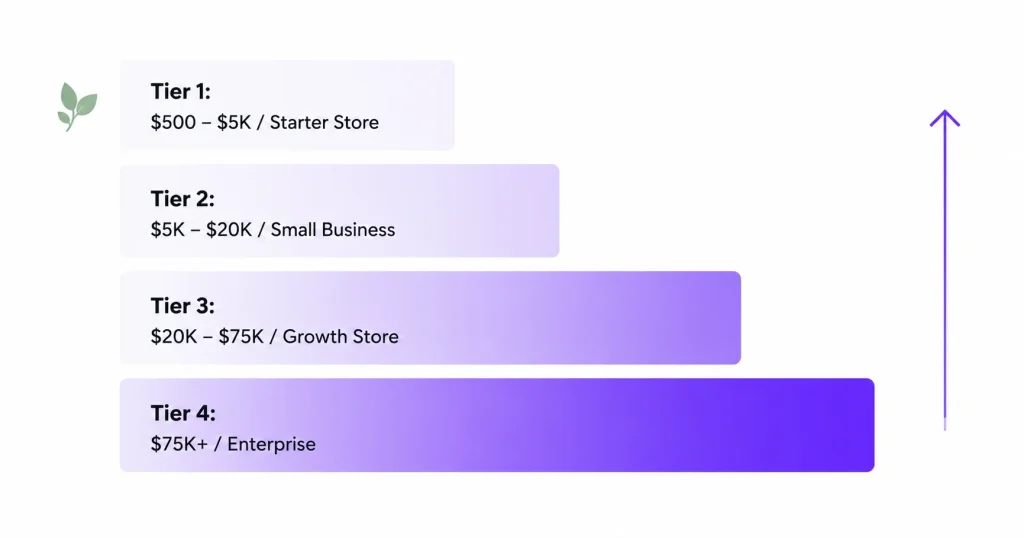
Template/Starter Build: $500 – $5,000
This is a pre-built theme on Shopify or WooCommerce with light customisation — logo swapped in, brand colours applied, products uploaded, and a working checkout. It looks professional and, if done correctly, it converts.
This tier suits solopreneurs, side businesses, or anyone testing a new product concept before committing to a larger build.
What agencies won’t tell you: a well-configured $200 Shopify theme on the $39/month plan is a perfectly legitimate foundation for a business doing hundreds of thousands in revenue. You do not need a $15,000 build to start selling online.
Professional Small Business Store: $5,000 – $20,000
This is where most small-to-mid-sized businesses should be shopping. At this tier you get a properly configured platform, a premium theme with meaningful customisation or a semi-custom design, structured product catalogue architecture, and core integrations like email marketing, abandoned cart recovery, and product reviews.
This tier suits established businesses that want a polished, branded storefront that performs not just looks good.
What agencies won’t tell you: the difference between a $7,000 and an $18,000 quote for this exact scope is almost always agency overhead and sales commission, not build quality or deliverable value. Always ask for a line-by-line scope breakdown before comparing quotes.
Mid-Market Growth Store: $20,000 – $75,000
At this level you’re getting fully custom design from wireframes up, advanced platform configuration (Shopify Plus, WooCommerce with serious infrastructure, or BigCommerce), complex integrations with inventory systems, CRMs, or third-party logistics providers, and a development team that actually knows what they’re doing.
This tier suits growing brands with a large SKU count, omnichannel requirements, or technical needs that standard templates genuinely cannot accommodate.
What agencies won’t tell you: Shopify Plus starts at $2,300 per month. That’s $27,600 per year in platform fees before a single line of code is written. Many agencies recommend it prematurely because it’s a premium product that justifies a premium build fee. Make sure your revenue and complexity actually warrant the upgrade before committing.
Real E-commerce Development Costs in 2026 — By Build Type
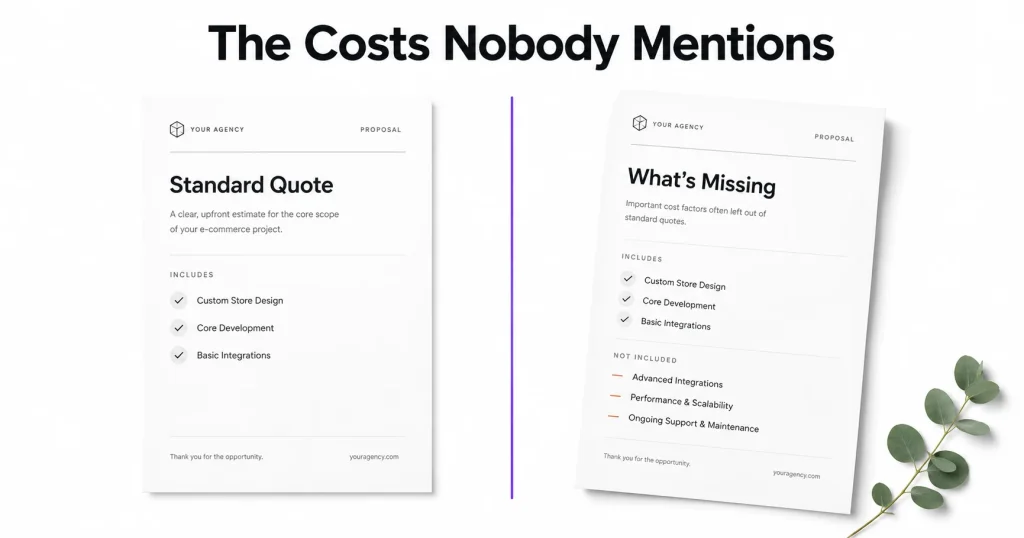
This is the section that costs business owners the most money — because nobody talks about it during the pitch.
Development of custom features. Most quotes cover a standard build. The moment you ask for anything non-standard — a custom product configurator, a trade pricing portal, a subscription mechanic — expect change orders. These typically get quoted at $100–$200/hour and aren’t flagged upfront.
Content migration. If you’re moving from an existing store, transferring product data, descriptions, images, customer records, and order history is a project in itself. Agencies often exclude this entirely. Migration work on a medium-sized catalogue can add $1,500–$8,000 to your bill.
Product data entry and photography. Your agency is building a framework — they’re not populating it. Uploading products, writing descriptions, and sourcing or producing photography is usually your responsibility or billed separately. Professional e-commerce photography runs $50–$150 per product. For a 100-product catalogue, that’s $5,000–$15,000 before development even begins.
Quality assurance and testing. A responsible agency builds QA time into the project. Many don’t. If QA isn’t explicitly listed in the scope of work, expect bugs post-launch — and expect to pay to fix them.
Launch support window. The first 30–60 days after a new e-commerce site goes live are always the most technically chaotic. There will be broken integrations, edge-case checkout issues, mobile rendering bugs, and things that simply weren’t caught in staging. Whether your agency covers this under warranty or bills it as a new project is a conversation worth having before you sign — not after.
Platform Development Costs Compared
Shopify is the fastest to build on and the easiest to maintain. Development costs are lower because the platform handles hosting, security, and most infrastructure by default. The trade-off is monthly platform fees and transaction fees if you use a third-party payment processor. Best for brands that want to move fast and keep technical overhead low.
WooCommerce gives you full ownership of your store on your own hosting. Development costs are comparable to Shopify but there’s more configuration work involved in setting up reliable hosting, caching, security, and performance optimisation. Best for businesses already in the WordPress ecosystem or those who want complete control over their code.
Magento / Adobe Commerce is the most flexible and the most expensive — both to build and to maintain. It’s genuinely powerful for complex enterprise requirements but wildly over-specified for most small and mid-sized businesses. If an agency is recommending Magento for your first e-commerce store, ask them very directly why.
Headless commerce (decoupled front-end connected to a commerce API) is the fastest-growing architectural choice in 2026 for brands that need extreme performance and design freedom. Development costs are significantly higher than traditional builds expect a minimum of $50,000 for a well-executed headless project. It’s not a solution for most businesses below $5M in annual e-commerce revenue.

5 Questions to Ask Every Agency Before You Sign
These questions will tell you more about an agency than anything in their proposal.
1. Can you show me three live e-commerce stores you’ve built in the last 12 months?
Not mockups. Not case study screenshots. Live, functioning URLs you can click through, test the checkout on, and evaluate on mobile.
2. Who actually writes the code — your in-house team or subcontractors?
This isn’t a negative question. Subcontracting isn’t inherently bad. But you have the right to know, and the answer should be reflected in the pricing.
3. What is explicitly not included in this quote?
Get the exclusion list in writing. If content migration, QA, post-launch support, and product data entry aren’t mentioned, ask directly whether they’re in scope or not.
4. What is your change order process?
Scope creep kills e-commerce projects. Find out how out-of-scope requests are handled, how they’re priced, and whether they require your written approval before work begins.
5. Do I own 100% of the code, design files, and assets at launch?
This should be a non-negotiable yes. Some agencies retain ownership of custom code to create dependency. Others use proprietary page builders that make it difficult to switch providers later. Get ownership confirmed in the contract.
What Good E-commerce Development Actually Looks Like
A competent e-commerce agency doesn’t just build what you describe — they build what you actually need. That means asking you about conversion goals before writing a single line of code. It means questioning features that add complexity without adding revenue. It means delivering a checkout that’s been tested properly on iOS, Android, slow connections, and edge-case browsers before launch day.
It also means handing over a store you can operate yourself. At the end of a well-run project, you should know how to add products, update pricing, run a promotional discount, and pull a sales report without calling your developer every time.
If an agency builds you something you can’t manage independently, they haven’t finished the job.
FAQ
How much does it cost to build an e-commerce website in 2026?
What is the cheapest way to build an e-commerce website?
How long does e-commerce website development take?
Is Shopify or WooCommerce cheaper to develop?
Why do agency quotes for the same project vary so much?
Final Word
E-commerce website development cost in 2026 is not a number you can Google your way to. It’s a number you arrive at by understanding your requirements, knowing the right questions to ask, and working with a partner that gives you straight answers instead of vague ranges and impressive-looking proposals.
If you want to know what your specific project would actually cost — not a range, not an estimate, a real conversation — that’s what we do at Axcilence. We build e-commerce websites that are engineered to perform, and we tell you the full picture before you commit to anything.
Visit axcilence.com/call to start the conversation.